
CMS ACCESS Is a Chronic Care Program. The Winners Will Treat It Like an Economics Problem.

by Vince Hartman
Aug 07, 2026
CMS just launched ACCESS, a new outcomes-based program for chronic care management. Read the model description and it sounds like a care delivery program. There's a physician Medical Director accountable for quality and safety, and payment is tied to whether patients measurably get better. Formally, it is a medical services model.
But look at the payment tables and a different picture emerges. The initial annual allowed amounts run from $180 on the behavioral health track to $420 for CKM, and follow-on years decline from there. Waive the beneficiary's coinsurance, as many participants will, and your Medicare portion on a behavioral health follow-on year is $72. CMS also holds back half of that until reconciliation, when your outcomes get graded.
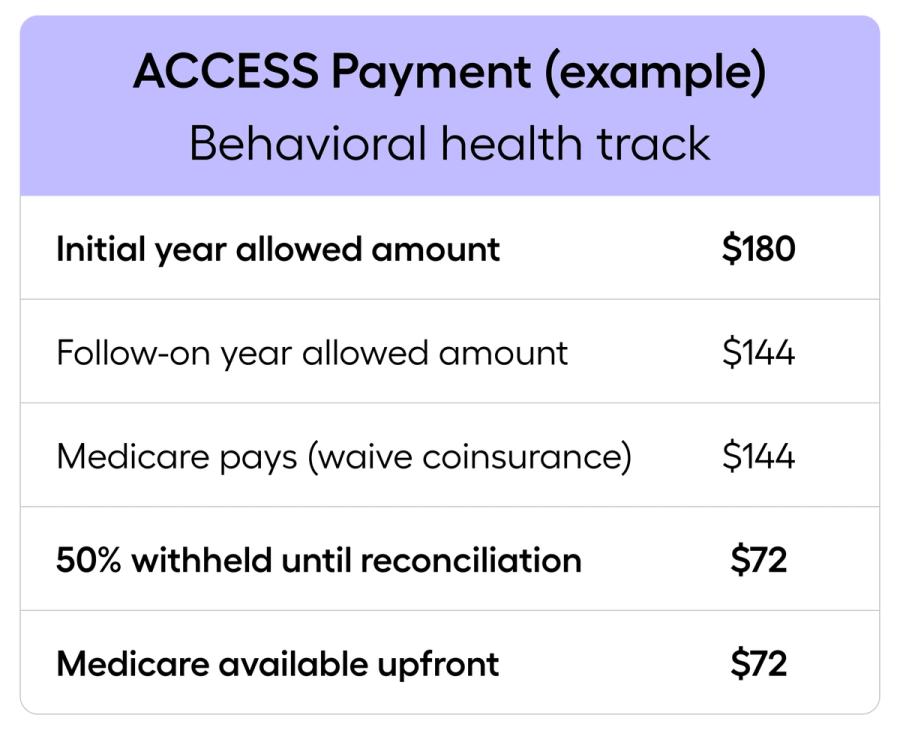
Seventy-two dollars. For a year of chronic care. With half of it withheld until you prove it worked.
Nobody is building a traditional care model on that. And I don't think CMS expects anyone to. ACCESS quietly demands something healthcare has never really built before. Care where the clinician touches almost nothing, and the infrastructure touches almost everything.
Here's an illustrative version of the math. A fully loaded clinical employee at $100,000 a year, spread across 25,000 enrolled patients, gives you four dollars of clinical labor per patient. Call it five minutes. That's not a rule CMS wrote anywhere, and the real number shifts by track and by what gets billed outside the program. But the direction is unavoidable. You're still funding consent, safety escalation, measurement collection, and CMS reporting on top of clinical labor, which makes the room for routine clinician time even smaller. Clinical time has to be reserved for the small share of patients who genuinely need judgment, and nearly everything else has to run without a human in the loop.
Now here's the trap. When a chronic care startup stares at those economics, the instinct is to build everything itself. Retrieve the records, parse the mess, build the AI analysis and the reporting evidence. It feels like vertical integration. It's actually strategic drift. What you do every day is what your company becomes, and a company that spends its operating life on record retrieval and data cleaning becomes a data analytics company with a care program attached. That is the wrong identity and the wrong risk profile for a business that gets paid on whether patients improve.
Because ACCESS has two jobs buried inside it. One job is knowing the patient. The other job is treating the patient. The programs that work will keep those jobs separate. Knowing the patient should be infrastructure. Treating the patient should be the company.
And knowing the patient has to be shockingly cheap. Not just for enrolled patients, but across the entire practice population you're screening to find them. The real financial killer in ACCESS isn't the cost of managing an aligned patient. It's the labor of sifting through everyone who might qualify. If eligibility screening isn't automated across the whole denominator, your care coordinators end up trapped in a manual triage loop and the economics break before a single patient is enrolled. The full patient intelligence step, retrieving the longitudinal record, extracting the measures that matter, and flagging who qualifies and what's missing, has to cost a few dollars per patient. That's not a CMS rule either. It's the constraint that falls out of the payment math. If establishing the patient picture costs fifty dollars, there aren’t many dollars left for patient care..
The good news is that this cost is front-loaded, not a treadmill. Knowing the patient happens once, near the start, and it tells you before any clinician spends a minute exactly what care each patient needs. Then the real operating dollars, on the order of thirty to forty a year depending on your track, go to the treatment layer that actually moves the outcome, and whatever remains is your margin. The discipline is simple. The cheap step of knowing the patient must never bloat into the budget meant for treating the patient.
Distribution follows the same logic. Beneficiaries can technically enroll directly, and some companies will try to build a consumer funnel where the patient retrieves their own records, hands them over, and signs up before anyone knows whether they're clinically relevant to the model. That workflow is backwards. You're asking a Medicare patient to do unpaid data collection work for a program whose value they can't see yet, and the highest-need patients are the least likely to complete it. When they get nervous halfway through, they call their PCP, who had nothing to do with it and now has uncompensated homework from a service they've never seen. You've spent marketing dollars to annoy the one person whose endorsement you needed.
ACCESS is designed to run in the opposite direction. Screen the treatment cohort first, identify who is likely eligible and why, and then reach out with a specific care reason. CMS built payments for the clinician relationship that makes this work, a $30 co-management payment when the referring clinician reviews a care update and documents a coordination activity, up to three times per patient per track per year, plus a one-time $10 add-on for helping the patient get set up. That's not a referral commission, and it shouldn't be treated like one. It's compensation for staying clinically involved.
I'll say this plainly. We didn't build Abstractive Health for ACCESS. We built it for pre-charting, for the doctor trying to understand a patient before walking into the room. But the pieces that problem forced us to build turn out to be the infrastructure layer this program demands.
We're already connected to the national health information exchanges, and we retrieve longitudinal records with nothing more than a name, date of birth, and sex, at retrieval rates above 95%. On top of retrieval sits our AI medical record summary, which turns a chart that would take hours to read into a narrative a clinician absorbs in minutes, with every sentence linked back to its source note. That provenance isn't cosmetic. When your outcomes get reconciled and your reporting gets reviewed, it's what lets you trace the information behind them back to the source. The same pipeline runs at cohort scale, so a practice can screen its panel in the background and surface who likely qualifies, what measures are stale, and who needs attention, before any staff member opens a chart. And we price it like infrastructure. Full record retrieval and AI analysis is inexpensive enough to make screening an entire panel economically sane instead of a triage project for your staff. Because clinicians already use Abstractive during real treatment workflows, the loop closes naturally. The clinician who knows the patient identifies eligibility, assists enrollment, and receives structured care updates back through the platform, which keeps their coordination documented and keeps them confident enough to refer the next patient. Distribution stops being a marketing expense and becomes a byproduct of care.
ACCESS is ultimately a test of whether healthcare can separate two jobs it has always confused. Knowing the patient, and treating the patient. The first is becoming infrastructure. The second is where care companies will win or lose. The ones that read it that way will be the ones still standing at reconciliation.
If you're building for ACCESS and working through how you'll screen eligible populations, retrieve records, and keep referring clinicians in the loop, come talk to us. We'd be glad to show you how it works.
--
At Abstractive Health, our mission is simple: empower clinicians with complete, accessible, and actionable patient data when they need it most. By delivering higher retrieval rates, requiring minimal inputs, providing faster access, and leading the field in clinically validated summarization, we're helping clinicians make faster, safer, and more informed decisions on their patients.
Clinicians can sign up here and see our technology in action for free, with quick access to see it in action for the patients they care for.
Related Articles

See the Abstractive Health AI assistant in action to discover what real efficiency can look like.
Try for freeStay ahead of the curve in healthcare innovation.
Connect
Abstractive Health
Resources
©2026 Abstractive Health. All Rights Reserved.
