
The EHR Does Not Tell You Who the Patient Is

by Vince Hartman
Jul 21, 2026
Electronic Health Records (EHRs) were not built to help a physician understand a patient before a visit, they were designed to document care for billing and compliance, manage orders, store the legal record, and satisfy reporting requirements. The top EHRs go as far as charging for coding and reimbursement capture, and their cost proposition has been tied to meaningful use / MIPS reimbursement penalties for not having one.
These functions matter, but are different from the workflow of precharting, where the clinician is basically trying to answer the question: “who is this patient and why are they here now?”
Over time, EHRs started to focus on creating better tools for clinicians to review records before a visit. But none of those tools are foundationally built for the precharting workflow because the core structure is still encounter-based billing. When a doctor thinks about how to care for a patient, they do not care if the patient’s medical information was captured in a billable encounter. They care that the information exists in a longitudinal structure of the patient’s medical history.
The structure of the billable legal record is not aligned with how a doctor thinks about care. The compliance side of a legal record is concerned with a specific event in time: who is accountable if something goes wrong, when an order was placed, who placed it, what was known during the clinical visit, and what documentation supports the cost and reimbursement structure for that visit. This is not how diagnostic reasoning works… Differential diagnosis depends on prior symptoms, medication changes, family history, imaging, labs and the small details that only become meaningful when they are connected.
This is why reviewing the patient record in an EHR means moving through scattered individual notes, usually from the same place or health system. These notes tell you what was documented at specific moments, but they do not necessarily tell you what matters now. The business value was that those notes were needed for billing, and more information was not necessary to capture encounter billing.
EHRs can now bring in outside information through Health Information Exchanges (HIEs), and that has improved over the last decade. But most of the pressure has been around making information available, not making it useful at the point of care. For a physician with minutes before a visit, a long list of outside documents is not meaningful. The EHR does not face the same business pressure to make that information clinically meaningful to the doctor. The primary buyer of an EHR is not buying it because they want to know their patient better. They are buying it to capture MIPS reporting, coding reimbursement, and store the record for compliance.
Here’s what that looks like in practice. A patient comes into the emergency department confused and agitated, and the doctor picking them up has never met them. Somewhere in an outside record from a hospitalization two years ago is the one fact that changes everything: an earlier episode that looked psychiatric at the time but turned out to be metabolic. That record may have even come across through an exchange already. But it is buried on page 140 of a scanned discharge packet, and the doctor has a few minutes. Whether that fact surfaces today is mostly luck. That is the gap.
So if the EHR is not doing it, what is needed to tell a clinician who the patient is?
First, you need their longitudinal record across facilities. That requires a robust patient matching algorithm that can account for prior addresses, name changes, and other patient matching complexity without the clinician having to know any of that, and without the patient having to reconstruct it for the administrative staff.
Second, you need to parse the records into a useful structure that places real emphasis on the unstructured clinical data in the original PDFs, images, and clinical notes. A list of prior diagnoses and medications from CCDs is not sufficient for a doctor to get meaningful value from a patient record.
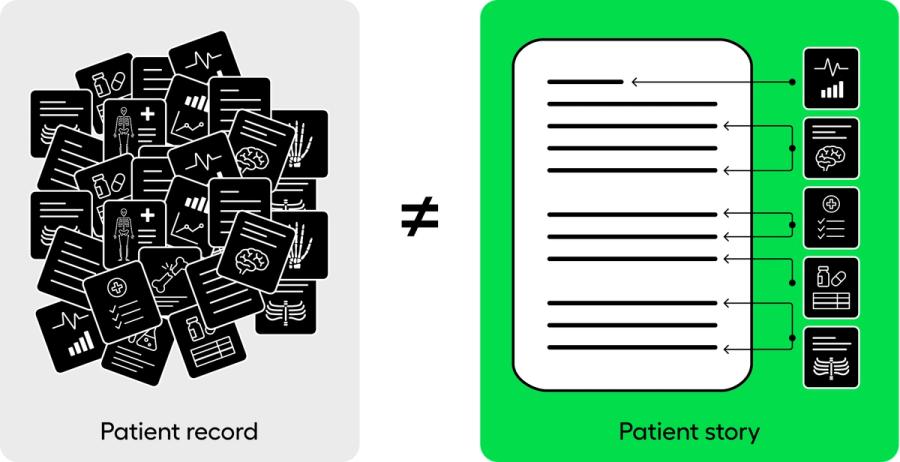
Third, you need a brief synopsis of the longitudinal record, so the doctor can get up to speed on the high-level information of the patient in two or three minutes. Otherwise, the clinician will not be able to quickly find the information of value and will fall back into recency bias or document-type bias. The most recent discharge summary is easy to find. It is not the patient’s medical story.
Fourth, every sentence in that summary needs to be traceable back to the source record. Since the doctor has no prior knowledge of the patient, the trust burden on the AI is higher. Without sentence-level provenance, a doctor cannot distinguish between a non-factual statement and a rare event on a patient chart. A statement that seems “clinically unlikely” based on the patient’s prior history may look like a hallucination. But it may also be the most important fact in the chart. If the doctor does not have a quick way to verify the content, how can they safely adjudicate between the two?
Without this baseline structure, which I think of as patient intelligence, clinicians are not really able to understand a patient chart before a visit. The EHR serves as a storage layer for billing and compliance documentation, but it provides no useful roadmap to actually know the patient. Patient intelligence is highly useful for improving care and helping a doctor perform at a higher clinical and operational level. It helps clinicians understand what matters, why it matters, and where it came from.
Healthcare has strong incentives to make documentation available, billable, reportable, and compliant. It has weaker incentives to prove that the information is clinically usable before the moment of care. And without a national compliance structure, EHRs have no general baseline incentive to build patient intelligence into their platforms.
Clinicians already understand this problem. If you look at physician forums, blogs, and personal stories, you will hear them spending 30 to 60 minutes precharting to uncover and review medical information. Patients feel it too. They bring prior medical charts to appointments and explain their history again and again because the doctor just does not know. The need is obvious at the clinical level. What has been missing is a scalable way to solve it.
That is why a new category is emerging around this problem: patient intelligence.
And as of now, it is becoming more obvious across the industry that the EHR has never really informed a doctor well before a visit about who their patient is. It has been a pretty unsafe process that we have taken for granted. And it is something AI can do a much better job at than current processes.
This is not just a workflow complaint. It is a safety gap. We have known for a while that adding structure at the moment of handoff helps. When nine academic hospitals rolled out a standardized handoff program called I-PASS, medical errors dropped 23% and preventable adverse events dropped 30%, without adding to anyone’s workload.
Abstractive Health recently ran a study to see if clinicians would actually use a patient intelligence layer and whether it changed their thinking. We built a deliberately messy longitudinal case, gave more than 1,300 clinicians only the source-linked summary and a way to query the underlying record, with no EHR and no decision support, and gave them 12 minutes. They consistently read the narrative first, used the source links to check the claims that surprised them, and then queried the record to fill in the gaps. And 16% of those who finished landed on the correct unifying diagnosis, acute intermittent porphyria, which takes an average of about 15 years to diagnose in real practice. Getting a meaningful share of clinicians there in 12 minutes, with nothing but a trustworthy view of the patient, tells you this first step can be made faster and safer.
The reason this category will likely emerge independently of the EHR is that the EHR will default to encounter summaries of the data it already has. It will automate the creation of notes like discharge summaries, visit summaries, and handoff notes. Those are useful. But they still operate inside a temporal visit context. They are not the same as a longitudinal, source-linked understanding of the patient before the doctor walks into the room.
Abstractive Health is one of the earliest companies emerging in this space of patient intelligence. Time will tell who else is suited to solve the problem of precharting for doctors. But the direction is clear. The EHR is the system of record. Patient intelligence is the system that tells you who the patient is.

See the Abstractive Health AI assistant in action to discover what real efficiency can look like.
Try for freeStay ahead of the curve in healthcare innovation.
Connect
Abstractive Health
Resources
©2026 Abstractive Health. All Rights Reserved.
