
When a Patient Says No to Record Retrieval

by Vince Hartman
Sep 15, 2026
Nationwide exchange frameworks like Carequality, and tools like Epic Care Everywhere, have quietly been one of the biggest wins for patient safety in the last decade. When a doctor understands the patient before walking into the exam room, they practice better medicine. Full stop. Precharting with outside records should be the expectation on every patient, not the exception.
And yet, every so often, a patient finds that intrusive. You took the time to know them deeply before they formally shared their story with you, and it unsettles them. Across the health systems and practices we work with, this happens rarely in our experience. But when it does, the patient can get genuinely irate, and it catches staff off guard. There is a whole thread of family medicine doctors on Reddit trading stories about this exact moment. You were practicing medicine correctly, and their discomfort is still legitimate. So it's worth knowing how to handle the conversation well.
Start with consent, not with an argument
The first thing to get right happens before any complaint ever occurs. Here's the framework most practices get slightly wrong. HIPAA generally permits providers to exchange records for treatment without a signed patient authorization. The Notice of Privacy Practices is a notice, not a permission slip: it explains how information may be used and disclosed. What adds real consent requirements is state law. Some states operate on an opt-out model, while others like New York require explicit opt-in consent, sometimes as its own separate document placed right after the NPP. So disclose clearly at check-in that you use a service like Abstractive Health to retrieve outside records and share treatment context back to the exchange, follow your state's specific process, and have counsel approve the form you actually use.
If a patient declines under your state's process or your practice's policy, honor it. That's the deal. Your front desk and registration staff should be trained to have that conversation, because they are almost always the ones who will.
What to actually say
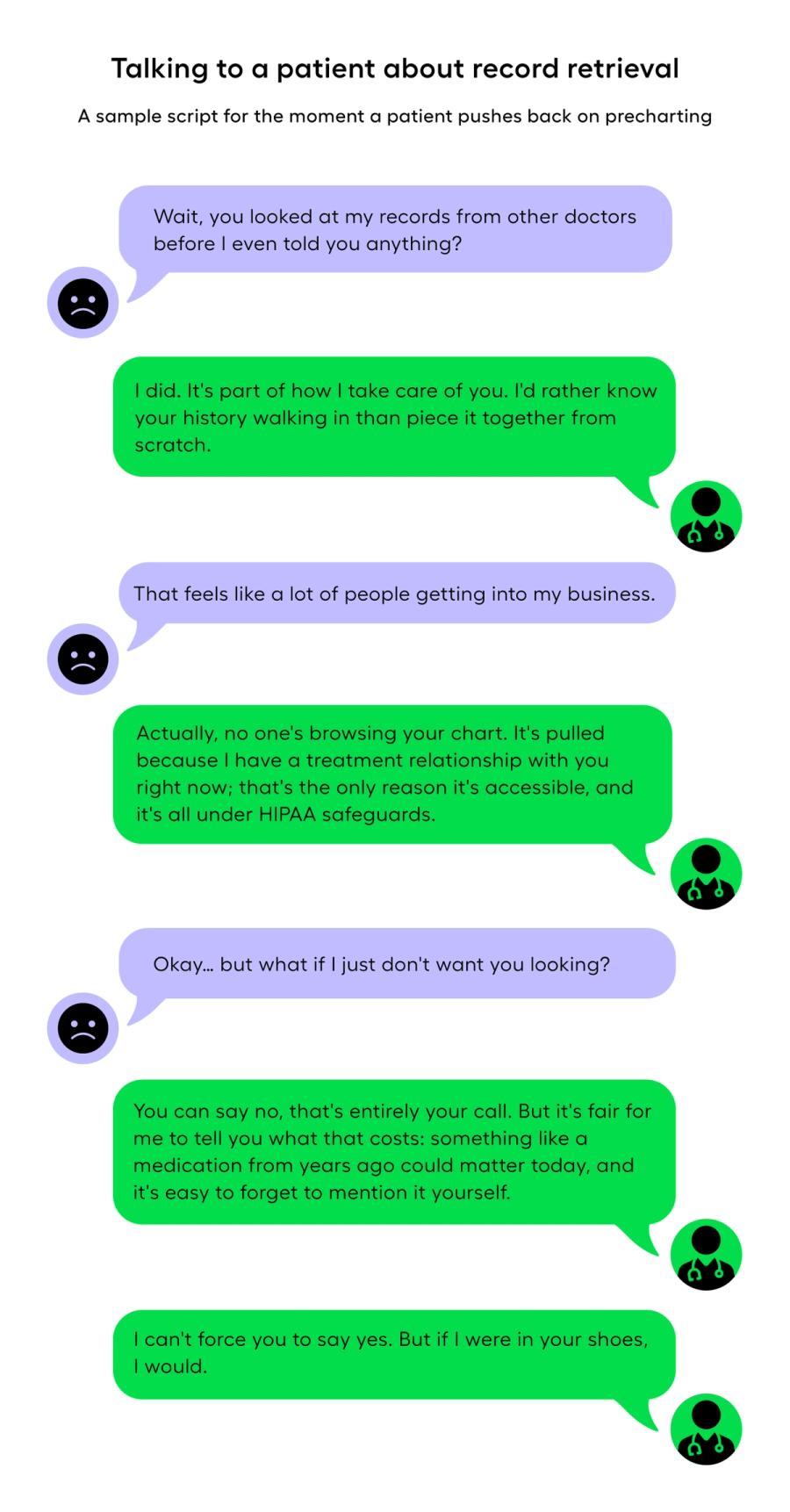
When a patient declines, the first thing they should hear is who actually sees their information. Records retrieved through a platform like Abstractive Health are pulled because a clinician with a treatment relationship is caring for that patient, with authorized staff and business associates operating under HIPAA safeguards to keep the system running. Their chart is not available for casual browsing. And by having access to their prior medical history, their medications, allergies, and clinical story, the doctor can make far more informed decisions. The provider is using a tool that condenses all of that into a succinct narrative that is genuinely useful for care. Even a record that turns up nothing relevant is useful information.
This matters most with controlled substances. Outside records can reveal a refill pattern across multiple clinicians that changes what is safe to prescribe. A patient's objection should never be treated as evidence that they are concealing something. But memory is not a medication history, and a doctor relying on recall alone is missing exactly the information needed to prescribe safely.
There's also a payment reality worth being honest about. If the patient declines the HIE but bills through insurance, the practice still has to transmit the claim information needed to pay that claim. Declining the HIE doesn't stop that. If a patient pays in full for a service and requests it, HIPAA actually requires the provider to restrict disclosure of that service to their health plan, unless disclosure is required by law.
This matters more than it sounds. Take a patient getting genetic testing who is worried about the results eventually reaching a life insurer. The ACA and GINA protect their health coverage, but GINA does not extend to life, disability, or long-term care insurance, and those underwriters typically obtain medical records through the authorization the patient signs when they apply. Meanwhile, billing the test through insurance creates claims data that may reveal, or at least strongly indicate, that genetic testing occurred. So the HIE objection is real, but it covers only part of the patient’s concern. The claims trail and any medical-record authorization signed during future underwriting are separate channels that declining clinical record retrieval does not necessarily address.
The distrust is rarely about the doctor
Here's what I've learned from these conversations. Often, the patient’s concern is not that their treating doctor will misuse the information. The recurring fear I hear is the government holding their data. A lot of Americans hate the concept of a universal medical record sitting in one centralized database, which is exactly why the United States doesn't have one.
Their records aren't stored on some central government computer. They live in the authorized record systems of the doctors who treated them. When a retrieval request goes out, the system queries the participating organizations it can locate and match the patient against, asking whether records exist. Only then do those records become available to the clinician treating them today.
Consenting to record retrieval through Abstractive Health does not create a government copy of their chart. The one honest caveat is that if they pay through Medicare or Medicaid, the government already holds their claims data, a coded billing picture of their history rather than the full chart, whether they consent to the HIE or not.
Knowledge is the resolution
In the end, the best way to handle a patient complaint about record retrieval is to give them knowledge. The system was built for their benefit, and your goal as the doctor is to treat them and make them better. The patient can decline wherever state law and your policy give them that choice.
Here you can view and download an FAQ to share with your patient, so they are better informed about how record retrieval works.
But it's fair to tell them what refusal actually costs. It is hard, as a patient, to remember that a medication from 15 years ago can matter to the visit happening right now. The health information exchange can surface it for you. That can be the difference between a safe, well-informed decision and a doctor practicing blind. And when the conversation has run its course, the most honest close a clinician can give is also the simplest one: “I can't force you to say yes. But if I were in your shoes, I would.”
--
At Abstractive Health, our mission is simple: empower clinicians with complete, accessible, and actionable patient data when they need it most. By delivering higher retrieval rates, requiring minimal inputs, providing faster access, and leading the field in clinically validated summarization, we're helping clinicians make faster, safer, and more informed decisions on their patients.
Clinicians can sign up here and see our technology in action for free, with quick access to see it in action for the patients they care for.
Related Articles

See the Abstractive Health AI assistant in action to discover what real efficiency can look like.
Try for freeStay ahead of the curve in healthcare innovation.
Connect
Abstractive Health
Resources
©2026 Abstractive Health. All Rights Reserved.
